Musings, Uncategorized

Crescent Moon

I am a crescent moon kind of girl. I love a crescent moon and I think it loves me back, it seems to be winking slyly at me from above.

People celebrate the full moon and call it by so many names, harvest moon, strawberry moon, blue moon. For me, the full moon is too pregnant with expectation. Bring this project to a close, tie up that loose end, get on with it already. The full moon makes me feel heavy, it is no wonder it makes some creatures howl at it and roam the dark countryside.

The new moon does me little good, hanging amongst the stars like a deflated basketball. It needs new ideas, beginnings and plans to pump it up. It brings pressure and promise and comes in empty-handed.

But ah, the crescent moon lingers in the balance between the two, neither here nor there with never a care. It slices the heavens like a sweet sliver of cake. It waxes or wanes between creation and completion, occupies the same space where I spend much of my time. Head in the clouds, biding our time. It asks nothing and takes nothing and together, we are suspended in the blissful peace of a thing half done.

A gibbous moon is nice, its belly full from a meal mostly eaten, the gaping line of its mouth swallowing the last remaining shadow. It is the friend who stays a bit too long, in an awkward silence that presses me to clear my throat and move things along. Almost time to put things to bed again as the full moon wraps an arm over his shoulder, telling him “step aside, it’s my time to shine”.

Animal Therapy

Cohesive

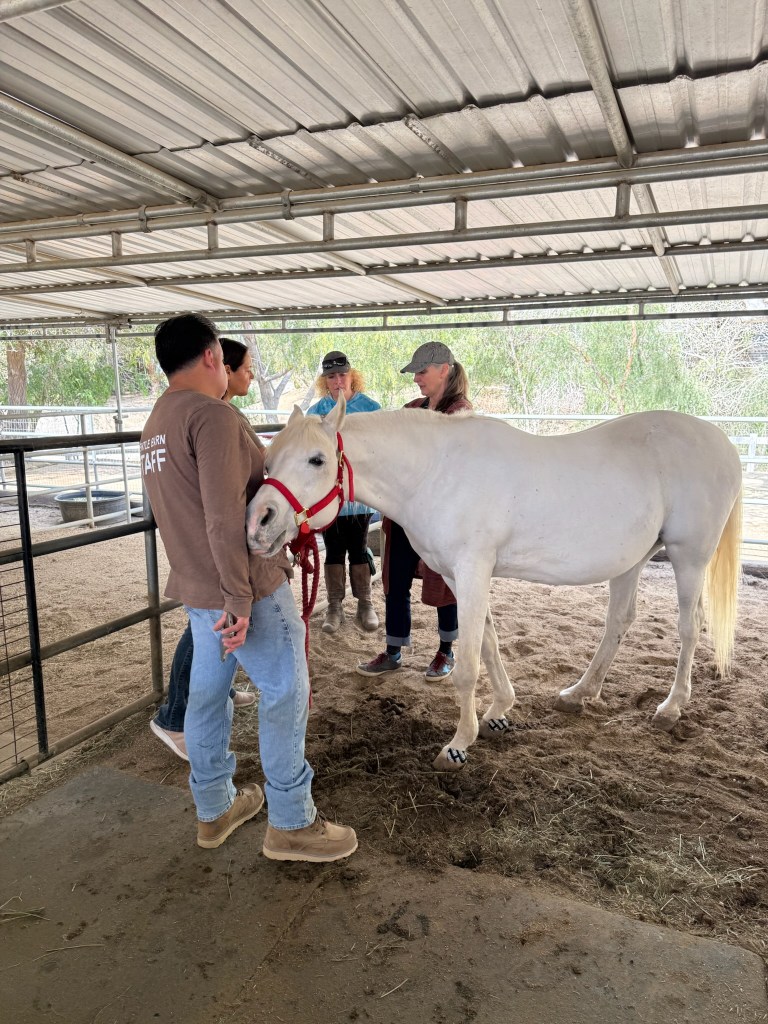
What a special pleasure it was this week to work with friends Joan Ranquet and Ellie Laks to help Danara, a sweet mare living her best life at The Gentle Barn in Santa Clarita, California.

I met Danara during a class field trip with students.  Besides being stunned by her beauty, I was drawn to her proud and lively energy.  Despite the telltale signs of progressive weakening in her legs due to DSLD and a twisted front leg from a previous injury, Danara exudes the spirit of her Arabian heritage and the light that shines from her large black eyes is magnetic.  I knew instantly that I could offer her some help. Thanks to lessons I have learned from Jade and Greystoke and Raffi, former residents at our retirement farm who also required management for progressive DSLD, I had a trick or two up my sleeve. (https://thehorse.com/1124890/updates-on-dsld-in-horses/)

Ellie Laks is founder and the powerhouse behind The Gentle Barn, a network of sanctuaries that offer a safe sanctuary for animals of all kinds.  They create the opportunity for people to come and commune with cows, pigs, sheep, horses and others through their Cow Hug Therapy programs and interactive tours.  Ellie’s connection to the animals in her care is palpable and Danara was no exception.  So when I suggested I could come out to show her a kinesiology taping pattern that I developed to help my own horses with DSLD, she lit up like a neon sign.

Joan Ranquet, founder of the Communication With All Life University and animal communicator extraordinaire, hosted our Foundation Level Massage course at her farm that same week.  Joan’s friendship and mentorship has been influential to me personally for over 20 years and particularly in recent years, where her professional mentorship has helped to elevate my school and practice to new heights.  I am so grateful for her gentle encouragement in the direction of all things right for the planet and her enduring curiosity and readiness to explore anything and everything that makes animal’s lives better.  She pulled all the threads together, including securing tape (I had not travelled with any of my usual tools), arranging schedules and singing my praises to make sure that doors opened to bring all the right people together.  So here we are, three influential founders within the animal healthcare industry on a Saturday morning, in jeans and tshirts doing what we love most, kneeling in the dirt, sharing our thoughts and concerns and skills to try our best to care for this beautiful little gray mare, cast off by others once they had broken her down and she could no longer live up to their expectations.

Danara stood patiently as our team of 5 taped all four legs.  Joan had invited her student Audrey, who was kind enough to drive from an hour away to bring the needed tape and her enthusiasm.  Ellie had included Alfredo, who is responsible for the rehabilitation efforts at The Gentle Barn and who Danara clearly was enamored of.  I walked them through the proper tape handling and measuring skills and designed a taping protocol that they could use for her regularly.  I coached Alfredo as he practiced the taping on a few legs.  With each relaxing breath, blink of her eye and lowering of her head, Danara shared her appreciation and relief.

I count myself among the most fortunate people I know.  I spend my days doing work I love, sharing my passion with students and graduates and horselovers and pet owners. I get to learn from the most amazing people within my chosen industry…my first mentor and coach Jack Meagher, Equi-Tape founder Dr. Beverly Gordon and my instructor and co-teachers Lumi Michelle Rolley and James Ruder, and countless others who have shaped the way I work and teach.  To bring that collective knowledge together, to kneel on a Saturday afternoon at the feet of this creature, so deserving and so accepting of our help, with these kindred spirits who live their life in the service of animals…I simply cannot imagine anything more rewarding.  To be able to offer support, touch and knowledge and to receive in turn warm breath across my cheek, a soft kind eye turned thankfully in my direction, to see the visible softening in the muscles and tendons that work all day to hold her up.

Such a simple thing.  From our childhood desire to pet horses, each of us had carved out a life that included doing just that day in and day out.  One horse, one story of so many stories.  We were just a few people, sitting in the dirt, playing with tape. We weren’t inventing anything new or solving world problems or changing the world…or were we?

Uncategorized

Magnifica

Chapter One: The Long Walk

Enzo Oliveri walked with deliberation, despite a leg twisted from an accident in his youth, and the weight of his possessions slung on his back. The mare walked carefully by his side, her rhythmic steps in concert with his jagged gait, offering him the support of her muscled shoulder from time to time. They had walked this way together for days across a broken landscape, rarely meeting another person or meeting them in groups of a dozen or more, pushing carts or pulling bags along behind them. Wanderers like him moving from place to place, many with no clear idea of where the road ahead led them. And though his own direction was unclear, he knew his goal with certainly, to lead Magnifica to safety. So they continued on, stopping only to allow her time to graze when the shoulder yielded enough green grass or to lead her to water. Enzo took his cue from her when she needed to rest or drink. Knowing that a horse would turn away from tainted water, he filled his own cantenna and drank only when she did. While she grazed or stood quietly napping with her head lowered and one hindleg cocked, he admired her fine bone and refined head, the wave of her black mane and her strong back. Sometimes he knelt beside her and prayed for their safety. In the dark of night, they walked if the road was lit by the moon or moved off the road into thicket or trees to sleep. He waited while she rolled and settled herself, then curled his crooked body against her body and slept with his head against her shoulder, rocked by the rising and falling of her massive ribcage. Day after day they traveled this way together. He lost track of time and then would find himself again according to the bells of a church or the sounds of vespers, or the trail of people moving toward a synagogue. But it seemed to him that it had been a very long time indeed since the deep tonging swell of a bell had reached his ears, even longer since he had heard a voice raised in prayer other than his own.

On one of these timeless wandering days, he couldn’t have said which, they came upon a young boy, standing squarely in the road, staring at some far-off place down the rutted road ahead. Enzo called out to the boy who turned startled and quickly made to move off. When he saw the bent man with his heavy pack and more so, the weary horse beside him, he skidded to a halt. They tried greeting one another, but neither knew the other’s language and so they gradually fell into step with one another silently. The boy was tired and didn’t mind the odd fashion that the old man walked and he was lulled by the steady clip-clop of the bare-footed mare. For days they continued this way, happy for each other’s company. They fed off food they found in the packs and wagons they found along the way, whose owners either lay dead in the streets beside them or had fled and abandoned possessions when marauders came upon them savagely. They rarely saw the enemy themselves and only occasionally were affronted by people they met. Perhaps they saw the crippled old man and felt sympathy or the fact that he traveled with a young boy who was pale and gaunt caused them to look away. Enzo often worried that someone would try to steal the mare from him, for transport or for food. He kept her covered in dirt and dust, and though her belly and back were protected by a layer of fat and muscle, he would lick his thumb and trace lines along her ribs in the dirt on her coat to make her look thin. To look at her as a stranger, she was unremarkable. Enzo liked it that way and encouraged her to carry her head lowered, take lumbering steps, and allowed her mane to be unkempt, hiding her neck and face. In fact, she was magnificent, as her name implied. Her legs were refined and her back coupled smoothly into strong flanks and hindquarter. She had large eyes and a wide brow and nostrils that tapered to soft lips. She was bred well and could move like the wind when called for. She was no more than five years, though Enzo feared that she no longer carried the foal that had been growing inside her when they first took to the road in his war-torn land. The entire landscape was ravaged by wars now, every country he could name was under siege, its people one moving mass of humanity, headed to some unknown place of peace. His only direction was ahead and if the road turned, so did he. He only knew to keep moving, to keep seeking, and to keep a close eye on the horse. If she showed signs of fretting, they hid quickly. When she raised her head and sniffed the wind, he looked around and then hurried both into the bushes and hid his pack. When she was restful, he breathed easier. He thought how lucky he was to have her with him, how clever she was and how well she protected them. They were never set up by surprise and it was not uncommon for them to watch from behind branches as small groups of soldiers or bandits passed by without a glance in their direction.

The wagons grew fewer and fewer and food was harder to come by. Water was everywhere and when they found clean water, they drank until their bellies felt full for it. They tried the grass and weeds that the mare sustained herself on. On rare occasions, Enzo would dig deep into his pack and pull out a tin of tea leaves and warm water over a tiny fire of leaves and twigs. He never let the fire run long, afraid it would be seen but also afraid of taking too much comfort from it and lingering in one place too long. But tea served not only as a meal but as medicine. The boy wrinkled his nose at its bitterness but drank it deeply and with gratitude. They shared only a few words…tea, rest, and her name. Enzo called her Magi, the boy called her Maggie.

As the days passed, the boy grew weaker. He was still growing and the bits of food they could find or scavenge from the land were not enough for his body. It was surprising to see the old man grow in his vigor while the younger grew less so. Enzo took great strength in his mission and it fueled him. The boy had no idea of passions or desires and only knew survival. At times, it seemed even that was of little interest to him. They walked as the sun grew high in the sky, the dust from the road stirred beneath their feet and irritated their eyes. The mare occasionally blew a great gust of air from her nostrils to clear them and her eyes were half-mast behind long lashes. Enzo held her rope in one hand and the boys in his other. Both felt thin and frail. He was deep in thought about what he should do, where they were even headed and when they would know they had arrived. He had no specific destination, barely a sense of where he was and certainly no plan that included a young child. Thankfully, he thought, it was a male child and not a young girl. Suddenly, the boy fell, jerking Enzo’s arm roughly and bringing him out of his contemplation. The boy stood with difficulty and slowly began to let out a wail, barely audible at first and rising to a dangerous pitch. Enzo saw the skin below the shorts the boy wore start to pimple up with tiny beads of blood where the dirt road had skinned it. He had no clean water with which to cleanse it and no wraps to bind the roughened skin. Had he, he would have chosen not to anyway, lest he trap an infection that would run out of control. Instead, he knelt beside the boy and used the clean inside of the cuff of his blouse to wipe a streak from his cheek. He took the boy’s face in his hands in the first gesture of affection that had passed between them and looked into crystal blue eyes damp with tears. You will be all right, he told the boy and though he knew he could not understand the words, he felt he was heard. And with that, he reached under the boys arms and lifted him up off the ground. He cooed to the mare and he laid the boy across her shoulder and with his other arm, deftly swung his back leg over her haunch. The boy had little time to be startled before he was settled on her back and looking down into Enzo’s face. The mare stood perfectly still though her ears flicked back and forth and her eye was trained on Enzo for assurance. He kept one hand on her neck and one hand on the boy’s thigh and eased her forward a step. The boy lurched and a timid yelp burst from his lips. Enzo took a length of the mare’s mane and tied it into a loop that he then handed to the boy and motioned him to hold. “Faeries stirrup” he said aloud to nobody in particular. Enzo had tried hard not to think about where he had left, to not see in his mind the cobblestone courtyard of the stud farm where he had grown from a boy to a stable hand to head groom under his father’s direction and the tutelage of the couple that owned the farm. But as he saw the boy curl his fingers around the mane, he remembered his own father doing the same and explaining to him that the tangles they found in the manes of the horse’s each morning as they came in from the field for their oats and apples were fashioned by faeries who rode them about the field in the night. As he allowed himself to get lost for a moment in the memory of his father’s face, the boy was forming his own memory. Never before had he viewed the world from such a position, to look through the ears of the mare at the world as she saw it. To feel her shoulders rise and fall under his knees and her hind feet coming solidly under her body to strike the ground. Magi felt the keen responsibility that had now been bestowed upon her. She had only had someone on her back a few times in her young years and none of them of recent. She gathered herself and despite her misgiving, carried herself as if she had been a riding horse all of her days. She felt the shifting wait of the little man aboard her and angled her body underneath him as she walked, cradling him as only a horse can.

Enzo meanwhile was struggling to keep the pleasant memory of his own boyhood from mixing with the images of his last hours at the farm. He had seen the soldiers driving toward the farm from the back of the horse he was riding that day, he was in the high field and knew he would have to gallop to reach the farm ahead of them. Even as he careened into the courtyard, the staff were running toward the stables frantically to throw open the stall doors before they desended. The gunfire started almost instantly and Enzo felt the horse whose reins he still held sink to the ground. He fled through the barn, stopping only for a moment in the tackroom to grab several files from a tall cabinet. He rifled through them for a moment and selected ten. Then he dashed out a side door from a washstall and ran in the direction of the mare’s field. Magnifica was there at the gate, whirling in panic and stomping the ground. It took him a moment to quiet her and lash a lead line around her neck. He led her as quickly as he could uphill into the trees so to be unseen. It was the long way around to a foaling shed that was located at the back of the pasture, near the skeleton of an old barn that had been the original stallion barn. There he tucked her away in a stall and threw hay down from the loft above to keep her occupied. And prayed she would not call out to the other horses. He stashed the files in the loft as well, under some old horse blankets and hay. Then he went to hayloft window and dared to look outside. The soldiers were standing about in the courtyard, there were two bodies on the ground, one human and one equine. From his viewpoint, he could not determine the one but he knew the other to be the horse he had rode in from the field on, a faithful and gentle old stallion long past his breeding years. Shots echoed from within the barn and a group of soldiers separated from the rest and headed toward the pasture. Enzo did the only thing he could think to do and hid. Only hours later did he emerge and sneak down to check on the mare. She lay on her sternum, nose in the hay, eyes closed. He watched her breath for a few minutes while he thought about what to do next. When he was confident that the silence outside could only mean that the soldiers had moved on, he went back to the loft and sought out the files. Gazing across the farmland from the hayloft, his heart sunk. Mares with their bellies slit end to end littered the pasture. There came no sound or movement from the great brick barn. His steps were heavy as he walked back to his apartment at the end of the barn aisle and gathered the few things he would need for the road. He buried the files in a pocket at the back of a knapsack along with a few clothes, a tin of tea, his best flensing knife and then headed for the feedroom. There he found his employers, draped across one another in death. With a few bandages, some medicine and what money he could find, he headed back to retrieve Magnifica. Ten stallions, each in their own stalls, laid dead. The foundation sires for the breed, gone forever. Enzo could not bear to look into the last stall, where the stupendous Greco was kept. Enzo had been at his birth, been the first to sit astride him, had shown Greco in the grand salons before the accident that left him with a leg that refused to straighten properly. He couldn’t bear to see his fate and could not leave without knowing if he could be saved. The stallion’s eyes stared skyward, cold and empty. Enzo’s hand went to his mouth and his heart locked in rage. He stumbled back to the pasture shed, past the mares who would never bear their fruit. He slumped onto the ground next to Magnifica and wept into her neck. And he prayed that the spirit of Greco was alive in her belly.

Musings

Reflections

Clean windows remind me of home and my 12 year-old self. At our house, window cleaning was an annual production for my mother and my sisters and I, although truth be told my sisters and I were often less than willing helpers. The brightening skies and fleeting warm weather of spring beckoned us out and stirred our need to venture not just outside the house, but out of the neighborhood. Our bikes begged to be freed from their moorings in the garage, where they had leaned on one another for support through the long gray days of winter. School was drawing to a close and friends from our block would come calling at the door, singing out my sisters name and mine. A gang would form down our street as each stop yielded up one or two children, the choir growing to six or eight before reaching our door, third house from the end of the street. My sister Rose and I knew who was gathering from several houses away, the thin pretty voice of our friend Annie, the boyish bark of Rachelle, the deep timbre of Olga’s syrupy voice. Even our dog would raise his curly black head when he heard the advance, tail thumping the floor in anticipation. What a strange lament we had created, seemingly out of no one persons doing, never discussed or planned, it just came to be. Someone stepped onto a porch and cried out, “Annie, Annie”. And then there would be two, “Shelly, Shelly” until a demanding song from a four foot tall choir rang out at our door, “Rosie, Rosie” but we were through the door before they could finish the verse. We were off and running and only the glow of the streetlamps would bring us back.

But for my mother, window cleaning was a resurrection of sorts. A throwing open of the doors to scatter the melancholy that settles into a home during a Michigan winter. It was her own spring catechism and it heralded a whole series of spring and summer sacraments, the hanging of laundry in the backyard, the rolling back of the pool cover and subsequent dredging of leaves from its depths, the tying of small metallic strips of paper to the stems of her sour cherry tree to scatter the early robins. It coincided with my father starting tomatoes and and fertilizing the raspberries in the backyard. It followed on measured steps behind Easter morning like a bridesmaid, when the dogwoods would be in blossom and often the last small flakes of crystalline snow would perch on their petals. My sisters and I would pile into the station wagon, careful of the hems of our dresses and ducking to keep the wide brim bonnets perched smartly on our reddish-blond heads, off to Easter Mass to shed the shackles of Lent. It would commence when the last of the hot crossed buns were eaten and it would last several days. Window cleaning came before the rising temperatures of May that would dry the cleaner before it could be wiped clean, leaving stubborn streaks across the glass. It was a harbinger of the planting that would come soon, delicate pentunias and bright marigolds that my mother would border her domain with, kneeling gently on one knee with a trowel in one hand and using her free hand to wave off the black cocker spaniel dancing at her feet in search of attention.

We would recognize its coming by the way she looked out the window at supper, silently counting in her head a string of reliably warm days. The gathering would begin, newspapers that usually gathered in stacks in the garage waiting for a school paper drive would collect in the dining room. An old sheet or my dad’s old work t-shirts would perch on the edge of the couch to be cut into tidy squares twice the size of her delicate hand in the evening. The scissors would snip away while we huddled around the tv or sat at the table finishing the last of our homework assignments, my father dozing off with his long legs stretched out before him and his calloused hands folded across his lap, the dog by his side, black muzzle resting on his pantleg.

Soon she would bend to the task of polishing the glass to gleaming perfection, giving her a perfect view of the outside world from a vantage point at the dining room table. When the work was done she could sit with a cup of tea in a rare moment of repose and look past the flower bed to her two youngest daughters playing kickball with the neighborhood gang. Her eyes would dart up and down the street when she heard one of us call out “Car” and scatter like starlings to the curbs until the car passed.

Window cleaning is on my mind today. The pandemic has as sequestered at home, businesses are closed, even church gathering forbidden. I am hosting an absurd number of conference calls online these days. During my most recent call, reflected on the screen infront of me, I caught the smudge of dog kisses that fractured the light coming through the bottom panes of the french doors leading into my office. My youngest terrier considers herself my personal assistant and insists on joining me in the office. Her plaintive whining and scratching at the french doors never fails to win me over and she spends the afternoon touring my desk, curling up in the discarded office chair that kills my back to sit in and brings me regular gifts of business cards and discarded receipts she roots out of the recycle box. I log in to my task tracking app and add Clean Windows to my weekend to do list.

I did not inherit my mother’s cleaning skills naturally, but thankfully she did take the time to teach me. No harsh soaps or detergents on glass because it might scratch the surface. A simple mix of white vinegar and warm water strong enough to itch the inside of my nose into a sneezing fit. I rummage our closets for fodder for several soft cloths (an old shirt from a 5K run years past, a flannel sheet that refuses to remain tucked in anymore) and rob the basket by the woodstove of a few pages of newspaper.

First the screens would have to come out. As a child we stacked these alongside the house where my father usually parked his beloved brown Ford pick-up truck, loaded down with a treasure of tools he used for his Italian tile and terrazzo business. His tile mosaics and marble floors graced the entries of buildings, fine dining establishments and posh homes from Grosse Point to Birmingham. As a grade school student, our classes would occasionally field trip to various Detroit area landmarks and I would recognize the perfect cuts and even caulk lines as we trudged single file through a foyer or inner sanctum of halls of government and historical homes. On summer weekends, my father would retreat to the driveway after Friday dinner and set to removing his tools from the bed of the truck and arrange them carefully in his shed and sweep out the bed. The truck had a bedcover, gray metal with windows on all sides. Into the back of the truck would go a full size mattress, blankets and pillows and a peach packing box of books and crayons and musical instruments. He would stock his glove compartment with mints and a deck of cards and shake out a quilt from a chest in the basement to cover the bench seat infront where my mother would sit. Bright and early in the morning, we would pile in to the truck. My mother and father in the front listening to NPR and my sisters and I in the back, a tumble of long legs and bare feet stretched out on the mattress, battling for space or lying head to toe. Usually we were headed for Canada to visit relatives but less often, a brown Coleman pop-up trailer would follow behind as we trundled off to a campground somewhere in northern Michigan or Minnesotta. We tumbled around, read books, napped, ate the nuts and fruit my mom had packed and when we bored of each others antics, we slid open the narrow window that communicated with the front cab and listened to the radio with our parents or begged for mints. My dad would feign that he had forgotten to pack any candy until we groaned and begged to stop. When we slipped outside the city limits, I would take my position at a side window and scan the countryside for any sign of horses. A few here, huddled together in a small pen beside a gray barn. A group of mares and foals scattered over a green expanse. A muddy group of ponies running toward a barnyard where someone was carrying out hay to a low wooden feeder. My favorite would be the farms where a horse or two grazed alongside a small group of cattle or sheep or when I would catch sight of someone near my age smartly trotting across a dirt ring on their horse, hair spread out behind them. Those trips sometimes ended with the pickup truck pulling into the driveway of my Uncle Johnny’s farm and I would blast out of the back of the truck bed and sprint to the field where my cousin’s mare Babe stood lazily swatting flies and a little black pony named Nipper raised his head and pondered whether this visit would require biting or kicking.

But when my mother had deemed it time, she whipped into a frenzy of airing out the house and my dad’s Ford was regulated to the curb. My father would be stationed in his driveway, hosing and scrubbing the window screens, watching as a graying stream of water and a few crisp corpses of flies meandered down the the sidewalk and to the sewer drain. My mother would be lining us up like soldiers and passing out assignments. It was critical that the cleaner be sprayed thinly over the glass and then quickly whisked off the surface with a clean rag. Someone would come behind that with a second rag to rub the surface free of streaks. If the window needed to be done twice, repeat the steps, no skipping. When rubbing, start in the upper left corner and work across the glass, repeating this in overlapping strokes to the bottom of the pane, never bottom to top. The final step, the window-cleaners piece de resistance, the secret weapon in my mother’s cleaning arsenal was a balled up piece of newspaper. We painted small slow circles across the glass with the newspaper, the siren squeek of paper on glass sending our dog under the bed and our cat to the neighbors yard.

Only yesterday I learned from my dad that the newspaper wasn’t to clean the glass but that the ink from the newsprint made the glass sparkle. It was the halo to crown my mother’s efforts. It created the glint off the glass that made her eyes sparkle in delight and our visiting aunt’s click their tongues in admiration.

I was in our farm garden, skyping with my mom and dad. They have been nearly 11 weeks in quarantine now. They are both in their 90’s, healthy and doing their best to stay that way. My daddy’s hair has grown over his ears and he is sporting a proper beard now. My sisters deliver groceries to the porch after carefully wiping them down and talk to my mom through the mail slot. I dream about that one night, that I am sitting on our little porch at home, my back against cool red brick with my sisters, my mom sitting on the tile floor of the foyer, leaning into the door so she can peer through the mail slot at her daughters, lined up outside like prisoners on the wrong side of this thing.We can’t go in, they can’t come out. Their yard has become their world, they can wave across the street to the young family that recently moved in, their three young children mystified by why they can’t go over to hear my dad play harmonica for them or eat muffins at the breakfast table with my mom. My mom smiles into her tablet from her living room chair and fiddles with the camera, my dad leaning on the arm of the chair behind her, one hand occasionally drifting across the silver hair of her head affectionately, absently. These calls have become a ritual for us both, I take them on virtual walks around the farm so they can see the horses, the trees and the rhododendrons in bloom. They come with me to work in the barn aisle, to see the coop that my husband has built for the hens from the safety of their living room. I am showing them the peas in the garden that are flowering and pulling weeds as we talk. There are tomato starts to put in the ground and I ask my dad about tying up the fig tree that is starting to lean precariously. He tells me that his tulips are done and it is time to decide if he is going to dig up the raspberries or try for another year. The soil has grown old and tired, he says, the irony doesn’t escape any of us. For the last 60 years my dad has worked it into rich black beds, but he isn’t sure he has the desire now. My sister usually brings him compost from her and her husband’s two horses but with the travel restrictions, she hasn’t visited in weeks and nobody can get to the nursery anyway, its been closed since the Governor declared a stay-in-place mandate.

I am reminded of my office windows. I ask my mom if she will be hiring someone to do the windows this spring and this is what leads us to talking about the best ways to clean the windows and to my father explaining the purpose of the newspaper.

After our call, I gathered my cloth and cleaner and newspaper. We haven’t bought a newspaper in years, gleaning all we need or want to know about the world news from the screen of our smartphone or computer screen. The only paper is a local store circular. I don’t think schools even have paper drives these days. I head for the French doors. Spray, wipe, rub. Spray, wipe, rub. I take my time doing one side of the pane and then going to the other side of the door to clean the opposite side. Then I go back and forth to find the streaks or smudges, leveling my gaze alongside the glass. It is mindful work, slow and deliberate. I miss my sister’s help.

Windows speak to me on a deeper level than a mirror. I have been looking through windows more and more of late, stationed at home as we are, hidden away from the coronavirus. I look out and count the blessings I see, the massive black figure of my horse grazing in our front pasture, the two statuesque cedars framing the grass field beyond where deer cross in the evening and coyote follow behind once the moon has sent the sun to bed. There has been a progression of growth since the start of the stay-in-place order. My front yard has paid no heed to the halt of activity that is evident in the streets of town. My front yard marches on, blissfully unaware. The bare Japanese maple has covered its crooked bones with a spring frock of dark rust colored leaves. The narcissus, also fans of their reflection, have come and gone, as have the daffodils and tulips. Noone had to tell them to stay in place, they held their ground as they always do and bent to the prevailing wind as needed until their time passed. They have been replaced in the deck pots by the rosemary and chives. The dandelions are busy shaking their manes loose on the breezes. Poppies bob their heads, just like I find myself doing late afternoons when there are no errands to hurry off to and nobody coming by to sit outside and share a meal or a glass of wine. Several of the rhododendrons are ablaze in blooms, while the others have begun to shed their sticky petals, which appear on our tile floor, traipsing in to the house on the pads of our dogs paws.

I am rubbing the cloth on the glass when it occurs to me why I prefer windows to mirrors. My husband has just walked into the room, drawn by the long sonorous whine of the glass singing under my ministrations. He looks perturbed for a moment, he is assuming I have locked my personal assistant in the office again and she is whining to be let out. When he sees me worrying away at the glass with my cloth, he smiles, standing a little longer than needed. He steps closer to the pane and looks through it at me, holds my gaze for a bit. Says nothing and everything in his constant way. I see us, myself and him, at the same time, overlapped, blended, separate but together. We are looking at the same thing but we are seeing it differently. It causes me to reflect on this moment in time in a new way. This new world insisting we look out at it through the paradigm of disease. For some, the view is terrifying, bleak, miserable, the glass permanently cracked. Others struggle to see through the clouded glass and feel stuck, uncertain about what they can’t quite see. Still others are looking for a silver lining, trying to see the light beyond the dark, peering into the now to try to see some glimpse of the yet to be, what people insist on calling the new normal.

All of us are looking out, but it seems all of us are seeing something different. We are separated by this disease, and yet we do see one another now, more than before. We are finding new windows, on our computers, between us and our teller, our grocery clerks, our barista. Some of us are staring directly into the window, hands alongside our eyes to narrow our view. Others glance sidelong at the glass, checking for shadows that blur all that there is in this. There are even those who would have you believe that they are offering you a window but thrust a mirror infront of you instead, have you believe in a picture they are creating behind the scene as if they were the Great Oz.

There is another reason I like windows. Yes, they remind me of my mother and a simpler and carefree phase of my life. Yes, they allow me a view of the beauty I am surrounded by on my farm and in my home. Yes, I feel deeply satisfied as I look through this clear firing of sand that I have polished clean until my view, at least, is crystal clear.

But more importantly, windows remind me that I have been looking into windows for as long as I can remember, the windows on the house of a soul. For the one other place where I can look and see both myself and the other, looking from the other side back at me is in the eyes of animals.

In the soft eyes of my horse, shining onyx from behind a mantle of long black lashes as I lean on his shoulder and he twists his neck around my body in a hug that brings us eye to eye.

The green eyes of our cat imploring me as he laces himself between my legs, tail ticking lazily in feigned interest.

The swirling flecked bronze eyes of my goats that spin with laughter and mischief.

The languid brown eyes of our oldest mare, who spends half her time on this side of the window in our world and half on the other side checking out the real estate and maybe looking for her next home and her former friends.

The extinguished light, flickering like a flame in a breeze, from the eyes of my heart dog as I cradle him in my lap, hold my breath as he takes his last in this form, in this life. His wise but pained gaze replaced by a youthful far away look as his soul spills out across the room and spreads itself into every corner of my life and my world, constantly reflected back to me in moments and surprise spaces.

I hope I take one thing into my new and changed life after this virus loses its hold on our collective pysche. I hope I remember to look into the eyes of others I meet with the same curiosity I feel when I look through windows. That I remember that they see me too. That they may see a different world than I but that we are not separate, there is no pane that separates us. That I can look at things directly or sidelong and the view will be different, and that it is okay to look at the same thing and see different things, as long as we look through it together. That I pause. To reflect.